Learning English grammar is an important step in helping children communicate clearly and confidently. Children use vocabulary to express their thoughts while grammar gives them coherent understanding. Young students find difficulty with verb tenses when they talk about things that happened in the past. Children who understand present perfect tense and past simple tense distinctions can speak and write correctly while avoiding typical errors.
This blog helps children understand basic grammar rules through simple explanations and common examples designed especially for kids. This provides essential skills for your child who needs to study for school exams or improve everyday English fluency.
Verb tenses tell us when an action happens. Without the correct tense, sentences may sound unclear or incorrect. Children often know what they want to say, but choosing the wrong tense can change the meaning completely. Learning how time works in English helps kids explain past events, talk about experiences, and describe completed actions correctly.
Children who learn grammar rules gain confidence in their speaking, reading and writing abilities. Storytelling comprehension and exam results improve students' mastery of tense. The ability to distinguish between these two tense forms which people frequently use, presents a vital achievement for English language development in children.
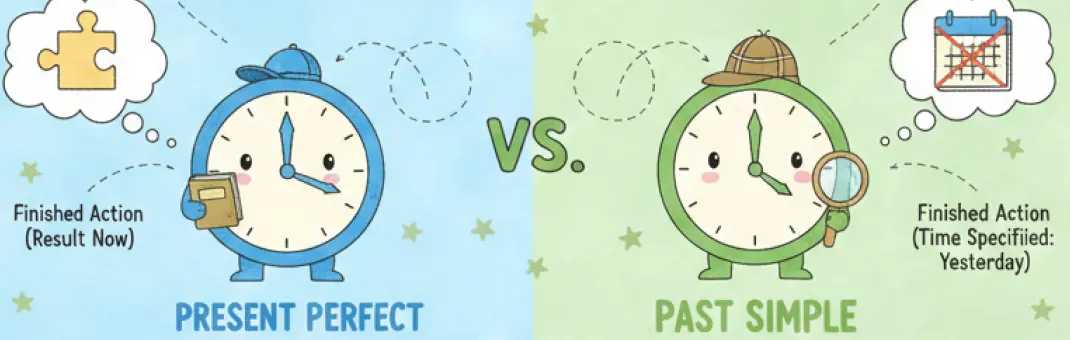
The past simple tense is used to talk about actions that happened and finished at a definite moment in the past. The past simple tense is used to describe actions that were completed in the past at a certain time. These actions are finished, and the time may be clearly stated or easily understood. This tense is commonly used when talking about yesterday, last week, last year, or any moment that is already over.
For example, sentences like "I visited my grandmother last Sunday" or "She finished her homework last night" demonstrate past events that do not affect the present time. The past tense used in this tense functions as a common element in storytelling, typical conversations and written narratives which children learn as their initial past tenses.
Most verbs in the past simple tense are easy to form. Regular verbs simply add “-ed” to the base form, such as “play” becoming “played” or “clean” becoming “cleaned.” However, English also has irregular verbs that change completely, such as “go” becoming “went” and “eat” becoming “ate.”
Children usually learn irregular verbs through three methods which include reading, listening and practice. The students start to understand these forms after they receive multiple exposures and training sessions. Students who understand verb changes can construct sentences correctly without any doubts.
The present perfect tense is used when an action happened at an unknown time in the past or when the result of the action is still important now. Unlike other past forms, this tense connects the past with the present, which makes it unique and sometimes confusing for young learners.
For example, when a child states, "I have completed my homework," his declaration shows homework completion at the present time and does not focus on when the homework was finished. The present perfect tense enables users to express their past experiences and achievements which create effects in their current lives.
The present perfect tense is formed by using has or have along with the past participle form of a verb. For example, the two sentences "She has learned a new song" and "They have visited the museum" show that past participles share their appearance with past tense verbs although some forms differ particularly with irregular verbs.
Children may take time to become comfortable with this structure, but consistent practice and clear examples make learning easier. Kids who comprehend this tense use it to share their life experiences and completed tasks.
The most important difference between these two tenses lies in time. The past simple tense is used when the time of the action is known and finished, while the present perfect tense is used when the time is not mentioned or when the action still matters in the present.
Consider these examples: "I lost my bag yesterday" establishes the time of the event through its precise date which shows when the action took place. The statement "I have lost my bag" demonstrates that the bag remains missing at this current moment. Children will find it easier to use the correct tense for their daily activities when they learn to recognize this particular distinction.
Certain time words act as clues when choosing the right tense. The past simple tense gets indicated by words that include “yesterday,” “last night” and “two days ago”. The present perfect tense uses “already,” “ever,” “never” and “yet” as common time expressions.
When teachers show children these signal words they enable students to find the right structure quickly. This skill becomes automatic through practice which leads to avoiding grammar mistakes.
At Learning Town, grammar is taught in a simple, engaging, and child-friendly way. The children acquire grammar skills through real-life examples which help them to practice with guidance and through interactive lessons, which create meaningful grammar experiences.
The concepts become clear through the explanation which shows children how to speak correctly and understand the reasons behind proper speech. Our method helps students develop confidence while they learn to ask questions and use grammar in their spoken and written communication. The learning process becomes both enjoyable and effective through this approach.
Understanding grammar does not have to be difficult or boring. When children learn concepts step by step with proper guidance, they gain clarity and confidence. The ability to use various verb tenses correctly helps children express their thoughts and enhances their complete language abilities.
Parents can enroll their children in Learning Town to receive essential English language skills, which will help them develop into successful English speakers. With expert trainers and a friendly learning environment, grammar becomes simple, practical, and fun.
If you're looking for a fun, engaging way to help your child become a confident, skilled reader and writer, look no further than our phonics class!
Copyright 2023 © Learning Town. Designed by SBBS.